Reclaimed Wood Fireplace Mantel Installations That Anchor Modern Interiors
Explore three reclaimed wood fireplace mantel installations that bring warmth and character to contemporary homes, from hand-hewn barnwood beams to live-edge…
Published · Reviewed by Lumbr editorial
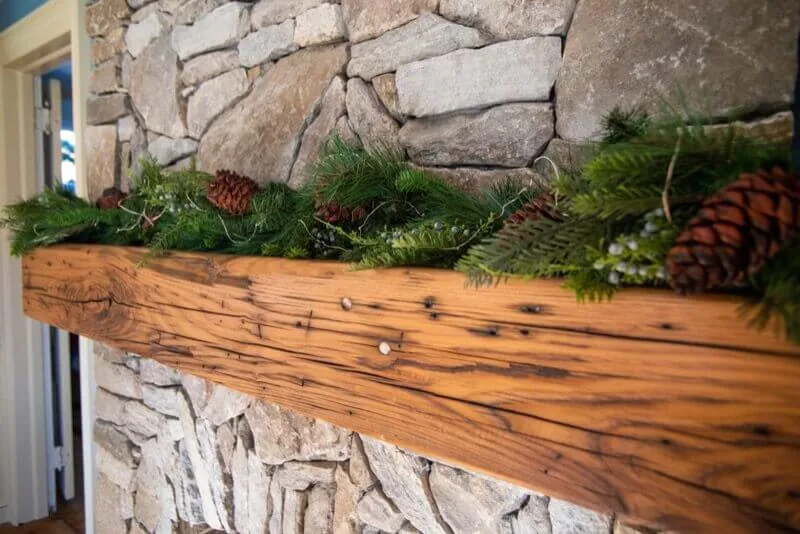
A reclaimed wood fireplace mantel does more than frame a hearth—it grounds an entire room in texture, history, and warmth. Whether salvaged from century-old barns or milled from weathered timber, these mantels carry the marks of their former lives: nail holes, checking, hand-hewn facets, and patinas that no stain can replicate. In modern and transitional homes, that authenticity becomes the counterpoint to clean lines and neutral palettes. The following installations demonstrate how designers and homeowners are pairing reclaimed mantels with stone surrounds, contemporary inserts, and both indoor and outdoor settings to create focal points that feel collected rather than composed.
Hand-Hewn Barnwood Over a Modern Glass Insert
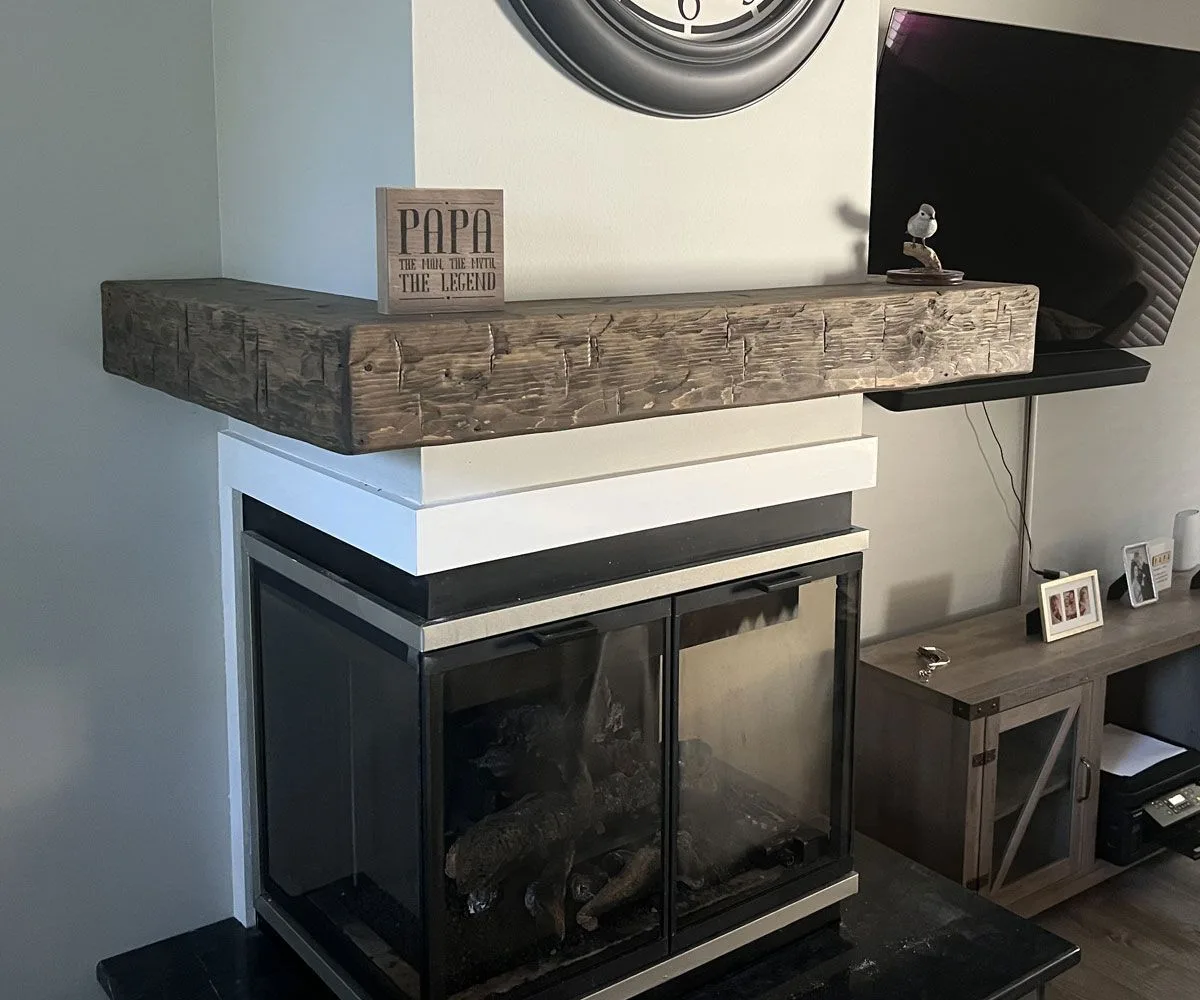
The Barnwood Collections in Valley City, Ohio, supplied a heavy beam-style mantel with a distressed gray finish that reads almost silver in certain light. The surface is pocked with nail holes and scored with the irregular facets left by a hewing axe—evidence of its agrarian past. That weathered patina plays beautifully against the white-painted surround and the sleek black frame of a modern glass-front fireplace insert below.
This kind of pairing—rustic reclaimed wood mantels set into crisp, minimalist architecture—has become a hallmark of farmhouse and transitional design. The mantel’s mass anchors the composition without overwhelming it, and its gray tones echo the cooler end of the neutral spectrum. A simple wooden sign rests on the shelf, underscoring the mantel’s role as both structural element and display ledge.
The installation shows how reclaimed barnwood can soften the austerity of contemporary finishes. The beam’s hand-hewn texture invites touch, while its age lends gravitas to a room that might otherwise feel too new.
A Screened Porch Fireplace Framed in Reclaimed Lumber
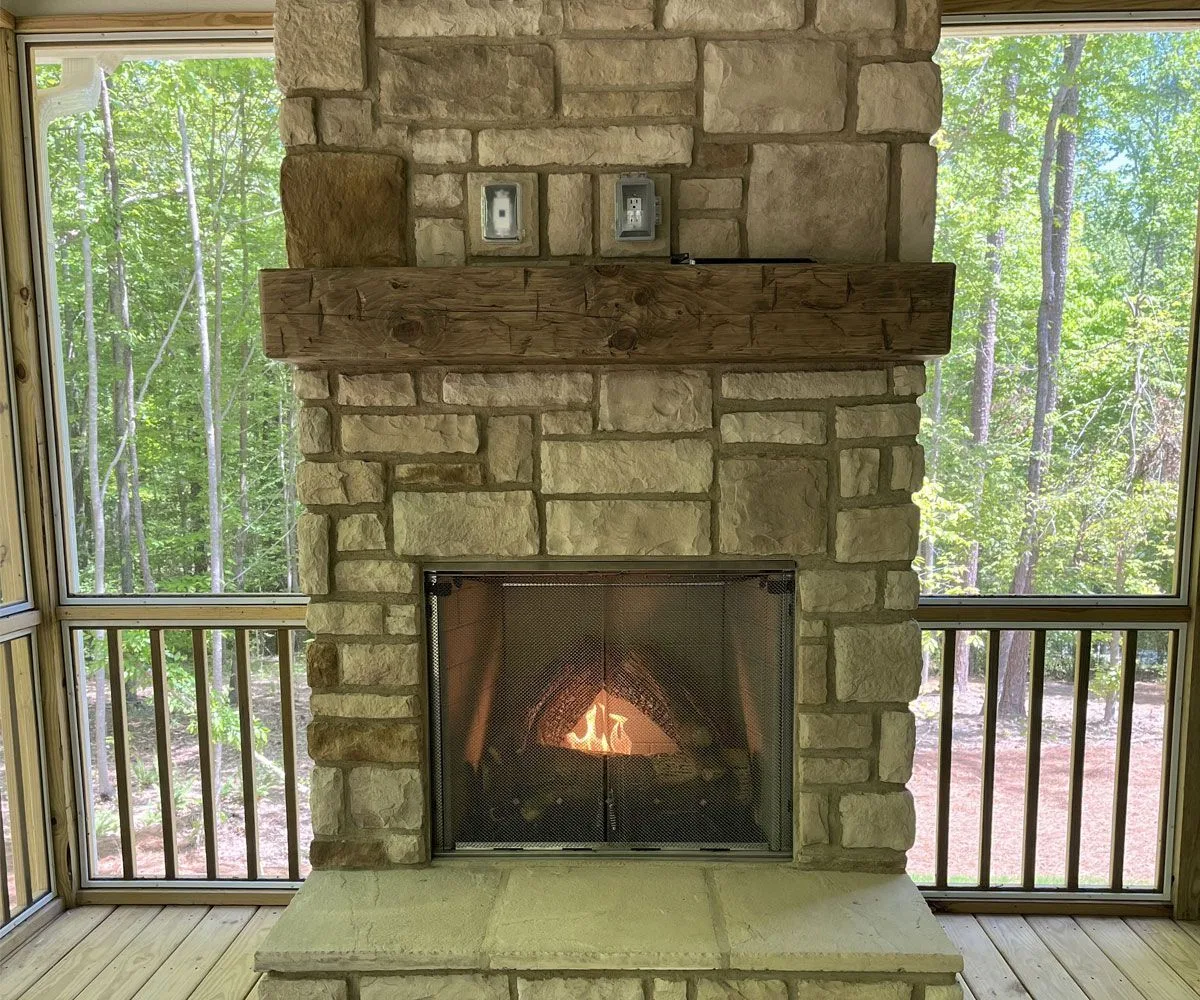
On a screened porch overlooking wooded acreage, another beam from The Barnwood Collections spans a stacked stone fireplace. This mantel is heavier still, with deep checking along its length, prominent knots, and edges that suggest rough-sawing or hand-hewing rather than planing. The wood’s natural imperfections—splits, voids, and color variation—mirror the organic irregularity of the stone below.
Outdoor and semi-outdoor installations demand mantels that can handle humidity swings and temperature shifts. Reclaimed lumber, already seasoned by decades of exposure, tends to move less than fresh-cut stock. Here, the mantel’s weathered surface feels at home against the forest backdrop visible through the screens, blurring the line between interior architecture and landscape.
The porch’s wood flooring and open sightlines reinforce the rustic vocabulary, but the fireplace itself—with its clean stone stack and recessed firebox—keeps the space from tipping into cabin cliché. The reclaimed mantel piece becomes the hinge between refinement and rawness.
Live-Edge Slab Mantel With Bark Intact
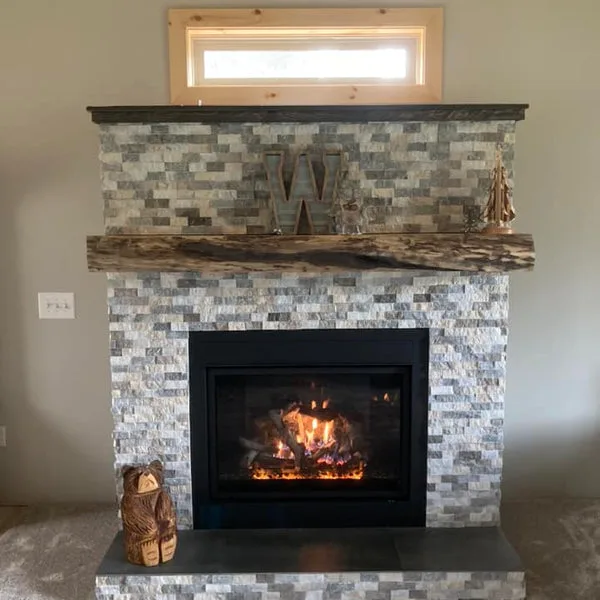
Homestead Timbers in Marne, Michigan, provided a live-edge slab mantel that retains its natural bark along both edges. The organic, undulating profile contrasts sharply with the geometric precision of the mixed stone and brick tile surround below and the black hearth at floor level. A dark upper shelf, likely added for additional display depth, floats above the slab, creating a layered composition that feels both sculptural and functional.
Live-edge mantels occupy a different aesthetic territory than reclaimed barnwood. Where barn beams carry the marks of human use—saw cuts, nail scars, weathering—live-edge slabs celebrate the tree’s original form. The bark, left intact, introduces texture and a hint of wildness. In this installation, that wildness is carefully contained: the slab is cleanly mounted, the stone surround is tightly coursed, and the gas insert is frameless and minimal.
The result is a fireplace that reads as modern rustic rather than purely traditional. The reclaimed wood mantel fireplace becomes a study in contrasts—smooth stone against rough bark, straight lines against organic curves, polished hearth against raw edge. A carved wooden bear on the hearth nods to the material’s origins without overstating the theme.
Reclaimed fireplace mantels succeed because they bring something irreplaceable: time. Whether sourced from dismantled barns, salvaged beams, or live-edge slabs, these pieces carry a narrative that new lumber cannot. In the right setting, that narrative becomes the room’s anchor, offering texture, warmth, and a quiet reminder that the best design often honors what already exists.
Image credits
Photographs are from the project galleries of the lumber businesses below. Each business name links to its profile on Lumbr; each "source page" link redirects out to the business's own site (we log referrals so we can share traffic data with featured vendors). If your business is featured and you'd like an image removed, email hello@lumbr.me .
- Homestead Timbers — Marne, MI
- Real Antique Wood — Irvington, NJ
- The Barnwood Collections — Valley City, OH