Live-Edge Coffee & Entry Tables: Small-Space Inspiration
Discover how live edge slab tables transform compact interiors. From walnut live edge coffee tables to organic entry pieces, explore designs that maximize…
Published · Reviewed by Lumbr editorial
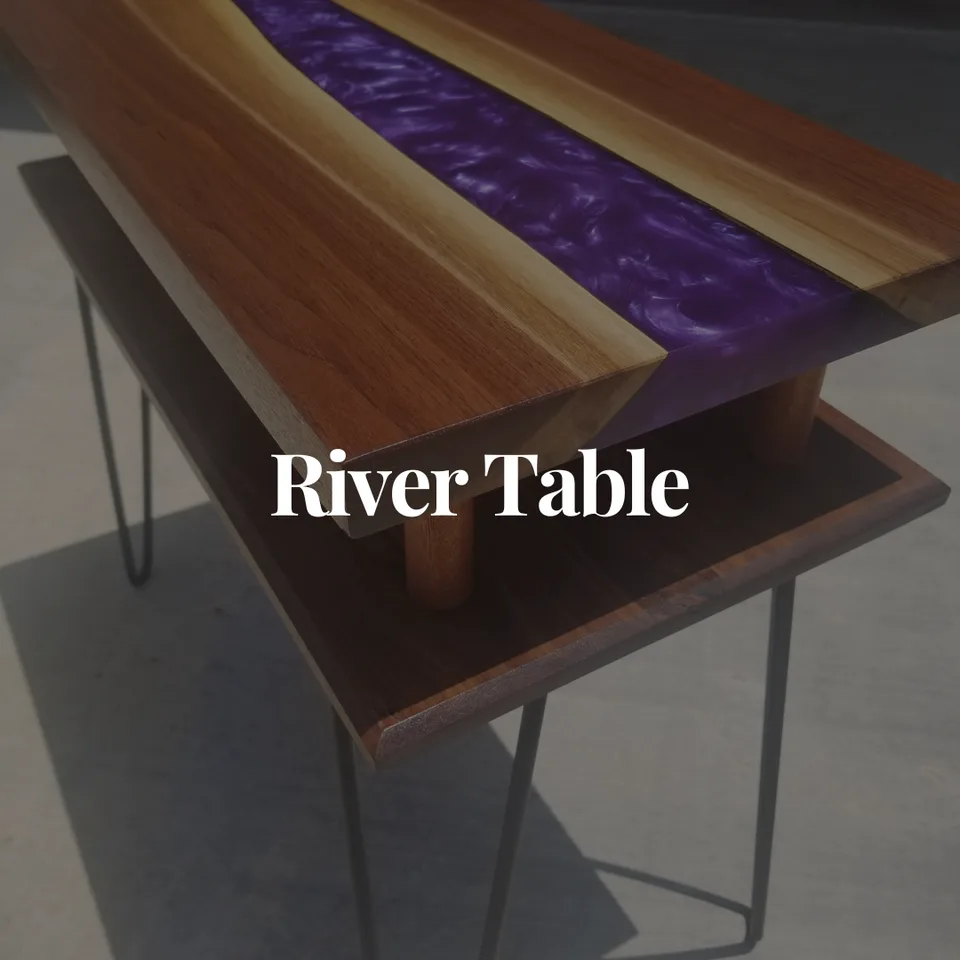
When square footage is at a premium, every piece of furniture must earn its place—not just functionally, but visually. A live edge slab table delivers that rare combination of sculptural presence and practical restraint. Whether anchoring a narrow living room or greeting guests in a tight entryway, these tables bring the organic drama of raw timber into spaces that can’t afford clutter but crave character. The key lies in selecting slabs that read as intentional: grain that draws the eye, edges that soften hard corners, and proportions calibrated to breathe rather than overwhelm. From walnut’s moody richness to lighter hardwoods that amplify natural light, the right live edge table top turns constraint into opportunity.
Walnut Drama on a Compact Footprint
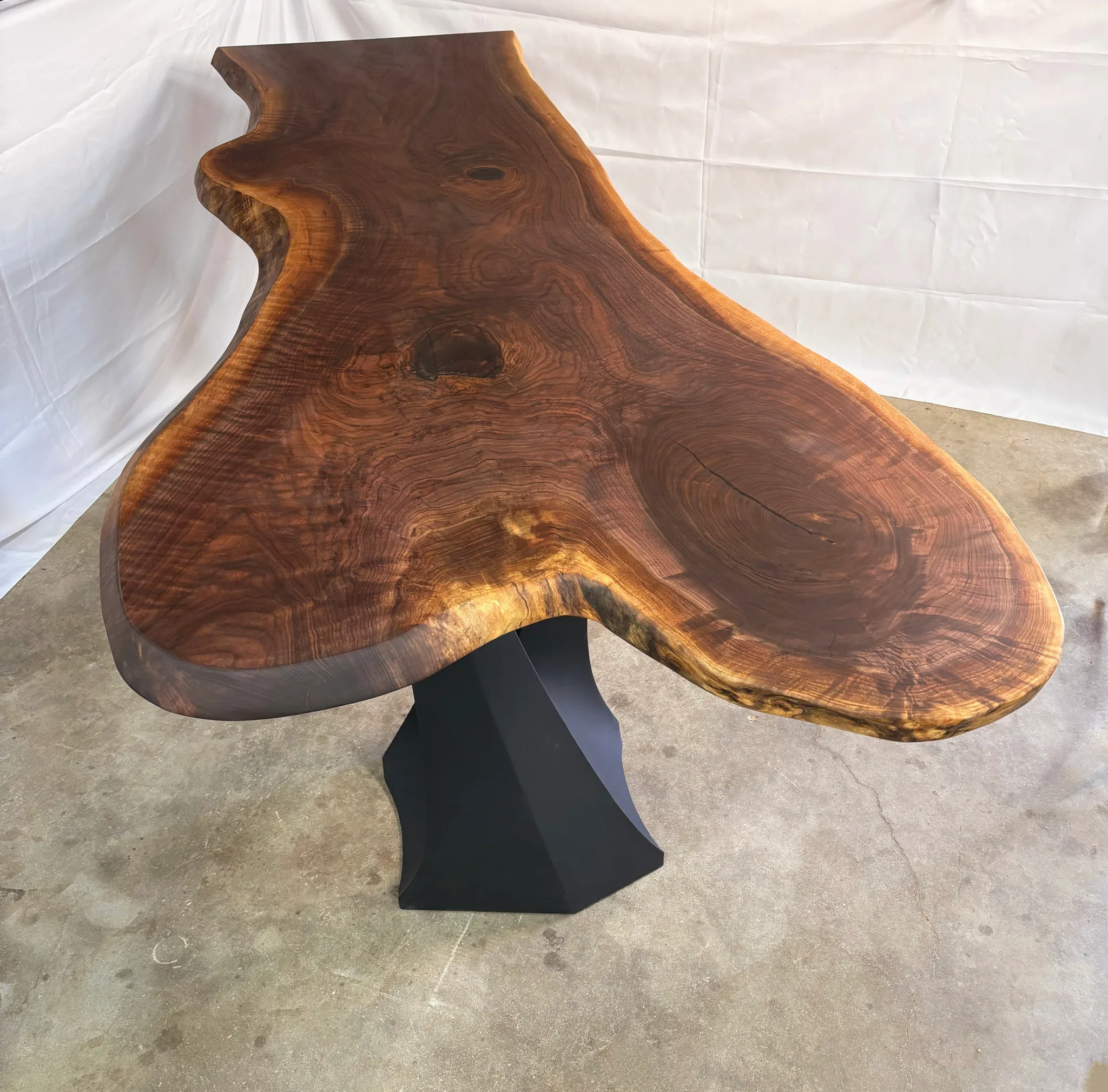
This walnut live edge coffee table from Two Fellers Live Edge Lumber in Coldwater, Michigan, demonstrates how a single statement slab can define a room without dominating it. The piece showcases cathedral grain and deep chocolate tones accented by golden sapwood, all brought to life under a glossy finish that amplifies the wood’s natural depth. Knots and organic edge contours trace the tree’s original growth, creating a silhouette that feels both wild and deliberate.
The contemporary faceted metal pedestal base is a study in contrast—geometric where the walnut live edge table top is fluid, matte black where the wood gleams. This pairing allows the slab to float visually, reducing perceived bulk even as the table commands attention. In a small living room, that sense of lift is critical: the eye travels under and around the form rather than stopping at a solid mass.
For designers working with compact layouts, this approach—bold material, restrained base—offers a template. The live edge tabletop becomes the room’s anchor, while the open base preserves sightlines and flow. It’s a piece that rewards close inspection but never feels heavy.
Nesting Organics for Flexible Layouts
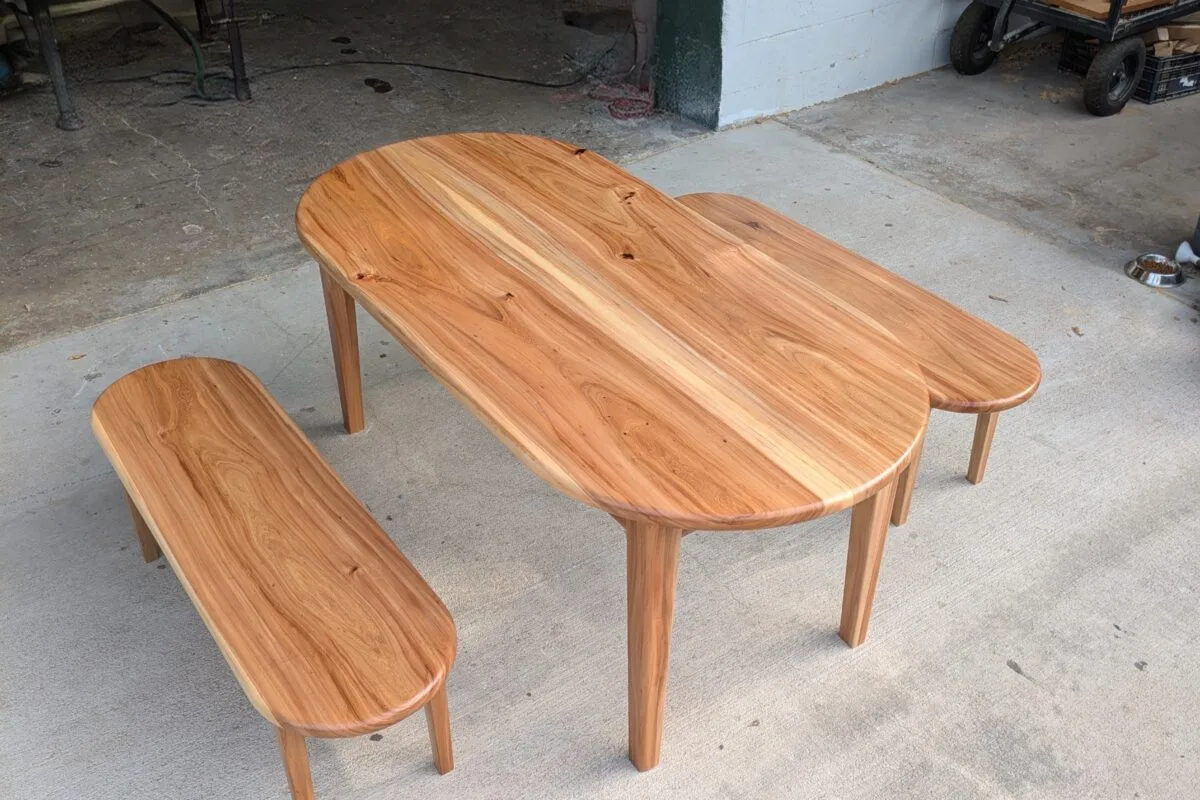
Harvest Lumber Company in Austin, Texas, offers a three-piece nesting set that rethinks the coffee table as a modular system. The main table and two matching side tables share rounded organic edges and a warm honey tone—likely oak or ash—with visible knots and straight grain that read as honest and unfussy. Tapered legs in matching wood keep the profile light, while the smooth finish highlights the natural coloring without adding gloss or artifice.
What makes this set particularly suited to small spaces is its adaptability. The side tables tuck beneath the main surface when not in use, collapsing the footprint to a single piece. When guests arrive or tasks multiply, they pull out to flank a sofa or serve as impromptu work surfaces. The rounded edges soften the geometry, making the pieces easy to navigate in tight quarters where sharp corners become hazards.
This is live edge thinking applied to everyday flexibility. The slabs retain enough character—knots, grain variation—to feel special, but the forms are controlled enough to layer and rearrange. In a studio apartment or a narrow den, that kind of versatility is as valuable as the wood itself.
Industrial Simplicity in Cedar and Steel
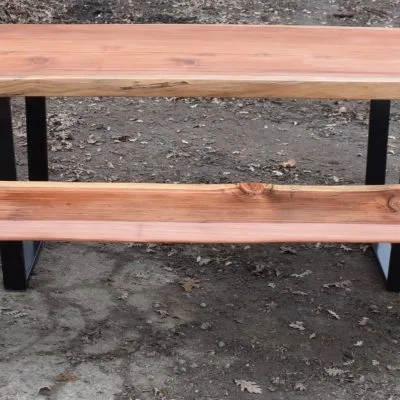
Hunski Hardwoods in Sacramento, California, pairs warm-toned cedar or redwood slabs with a black metal frame in a two-tier design that balances rustic texture and industrial clarity. The wood shows natural knots and grain throughout, with a lightly finished surface that preserves the material’s reddish-pink warmth. The metal legs—clean, angular, unapologetic—provide structural contrast and visual breathing room, elevating the slabs without fuss.
The two-tier configuration adds a practical dimension: the lower shelf offers storage or display space, doubling the table’s utility without expanding its footprint. In an entryway, that second surface holds keys, mail, and small plants; in a living room, it’s a home for books or a tray of glassware. The open frame ensures the piece doesn’t read as bulky, even with the added layer.
This approach—unfinished or minimally treated wood, straightforward metal joinery—suits spaces where honesty trumps polish. The live edge slab table top remains the hero, but the frame does quiet, essential work, grounding the organic form in a language of function and restraint. It’s a piece that fits as easily in a loft as a cabin, adapting to context without losing its voice.
Small spaces demand furniture that works harder and looks smarter. Live edge slab tables meet that challenge by collapsing sculpture and utility into a single gesture. Whether you lean toward walnut’s drama, modular flexibility, or industrial simplicity, the right piece transforms limitation into design clarity. Choose slabs that speak to your space, and let the wood do the rest.
Image credits
Photographs are from the project galleries of the lumber businesses below. Each business name links to its profile on Lumbr; each "source page" link redirects out to the business's own site (we log referrals so we can share traffic data with featured vendors). If your business is featured and you'd like an image removed, email hello@lumbr.me .
- Harvest Lumber Company — Austin, TX
- Hunski Hardwoods — Sacramento, CA
- The Lumber Shack — Des Moines, IA
- Two Fellers Live Edge Lumber — Coldwater, MI